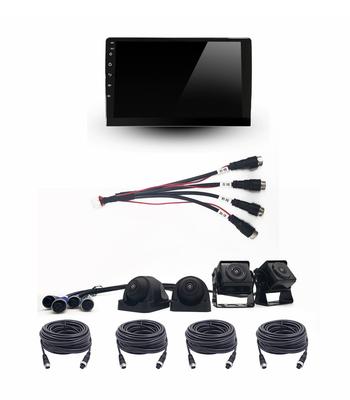
2. Core Product Advantages: Standard VS Custom Main Units
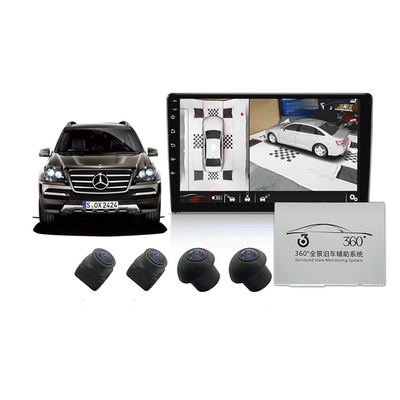
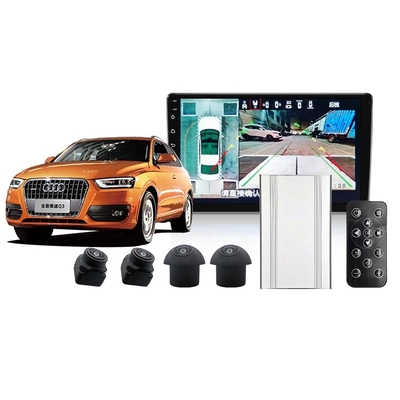
The essential difference between standard and customized 360° main units lies in adaptability and scalability. Standard units focus on universal compatibility and cost reduction, while customized solutions take vehicle characteristics and scenario demands as the core, achieving all-round upgrades in algorithm calibration, hardware matching, functional customization, and environmental adaptability.
Algorithm and Image Stitching Adaptation. Standard 360° main units adopt fixed universal stitching and distortion correction algorithms, with unified parameter settings for all vehicle models. When applied to long-body commercial vehicles or high-chassis engineering vehicles, rigid algorithms cannot match actual wheelbase and body data, resulting in common problems such as ground deformation, splicing dislocation, blurred edge details, and inaccurate distance judgment. In contrast, customized main units support adaptive algorithm calibration. Professional parameter debugging is carried out according to the actual body structure of different vehicles, realizing zero-gap seamless splicing and real scene restoration. Whether it is a short-body sedan or a 10-meter-long logistics truck, the customized system can output accurate and consistent panoramic bird’s-eye views.
Full Sensor Compatibility and Imaging Optimization. Universal main units are only optimized for entry-level image sensors, with poor adaptation to mid-to-high-end starlight-level cameras. They cannot exert the low-light sensitivity of SC2336, the WDR wide dynamic performance of JX-H63, and the ultra-high definition and zero-smear advantages of IMX545, resulting in wasted hardware performance. Customized main units support full adaptation of all mainstream 1080P sensors in the industry. The built-in independent image enhancement algorithm performs targeted optimization for different chips: enhancing night color restoration for starlight sensors, strengthening backlight suppression for high-dynamic sensors, and optimizing high-frame-rate stability for high-speed imaging sensors, maximizing the core performance of each camera hardware.
Scenario-Based Functional Customization. Standard main units adopt a unified functional template, only retaining basic panoramic display and simple cycle recording functions, without differentiated scenario design. Customized main units support modular functional combination and flexible expansion according to user needs. For private passenger cars, the system simplifies redundant functions and focuses on parking assistance and daily driving recording to improve user operating experience. For fleet logistics vehicles, it expands DVR data compliance recording, driving trajectory tracking, and collision automatic locking functions to meet industry supervision standards. For engineering and sanitation vehicles operating in complex working conditions, it is equipped with BSD blind spot monitoring, ADAS early warning, and 4G remote cloud monitoring functions to realize active safety protection and remote fleet management.
Environmental Adaptability and Hardware Matching. Standard main units only support conventional 12V vehicle power supply and single standard interface, with ordinary heat dissipation and shock resistance design, which are only suitable for mild urban driving environments. Customized main units support 12V/24V wide voltage adaptive matching, compatible with AV, USB, LVDS and other multi-protocol interfaces, realizing non-destructive installation for various vehicles. Meanwhile, customized industrial-grade hardware design supports high temperature resistance, low temperature stability, and anti-vibration interference, which can operate stably for a long time in harsh scenarios such as dust, high temperature, and bumpy roads, fully meeting the operational needs of special vehicles.
3. Industry Prospect
The market competition of 360° panoramic vision systems is gradually shifting from hardware camera parameter stacking to main unit algorithm strength and scenario adaptation capability, and customized main unit solutions will become the mainstream development trend of the industry. According to industry market data, the global automotive 360° surround view system market is maintaining a steady growth rate, with the aftermarket commercial and special vehicle segment growing the fastest, which puts forward higher personalized requirements for panoramic system solutions.
From the perspective of market demand, the continuous expansion of commercial fleets, engineering vehicles, and modified vehicle markets has completely overturned the single demand of the traditional universal market. More fleet enterprises and professional users no longer pursue low-cost universal equipment, but pay more attention to scenario matching, system stability, and functional compliance. Customized main units can accurately solve the adaptation pain points of different vehicle types and working conditions, filling the market gap that standard products cannot cover. In addition, with the popularization of intelligent driving technology, users’ demand for auxiliary safety functions continues to upgrade, and the scalable performance of customized main units can well adapt to subsequent function iteration and technology upgrading.
From the perspective of industry policy and supervision, global vehicle safety management standards are becoming increasingly stringent. Commercial vehicle transportation, engineering operation, and public transportation industries have clear mandatory requirements for vehicle visual monitoring, data storage, and safety early warning. Customized 360° main unit solutions can carry out targeted function development and parameter calibration according to the compliance standards of different industries, helping enterprises meet regulatory requirements and realize standardized operation.
4. Conclusion
Standard universal 360° main units are suitable for basic and standardized driving scenarios, meeting the low-cost and simple safety needs of ordinary family cars. However, in the face of diversified vehicle types and complex and changeable operating scenarios, the limitations of universal solutions are irreparable. As an upgraded industry solution, customized 360° main units achieve accurate matching of vehicle models, hardware sensors, and scenario functions through adaptive algorithm calibration, full-dimensional hardware compatibility, modular function expansion, and industrial-grade stable performance.
From passenger cars and commercial fleets to engineering and special vehicles, customized 360° main unit solutions break the one-size-fits-all dilemma of traditional equipment, maximize the performance of panoramic camera hardware, and provide targeted safety vision solutions for different application scenarios. With the continuous upgrading of automotive safety standards and the increasingly refined market demand, customized scenario-based 360° main unit systems will gradually replace universal standard products, become the core configuration of modern vehicle panoramic vision safety, and lead the innovative development of the global automotive vision accessory industry.